

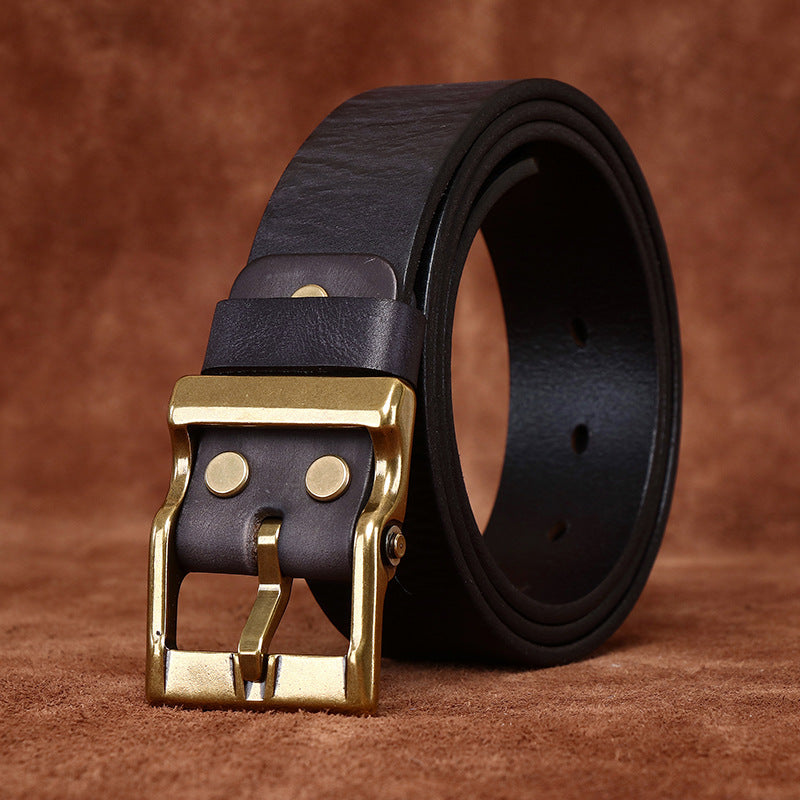
Choose a leather belt by its fit measurement first, then its width, buckle and finish. The whole strap length is not the distance that sits around you. Measuring a belt you already wear helps avoid an otherwise good choice arriving in the wrong size.
Measure the belt that already fits
- Lay your comfortable belt flat without stretching it.
- Find the fold where the leather turns around the buckle. Use that starting point for the KAKAVY Vintage Distressed style shown below.
- Measure from that fold to the hole you normally fasten. Keep the number and its units together.
- Compare that measurement with the fit size on the product page, not the strap's end-to-end length.
For the Vintage Distressed Top-Grain Leather Belt, the reference fit is measured to the fourth hole in a seven-hole layout, with holes spaced one inch apart. If your measurement falls between available sizes, the current product guide advises choosing the larger option.

No belt to compare? Measure around the place where you wear one, with the trousers you plan to use. Then check the instructions for your chosen belt. Trouser labels vary, and a belt worn lower on jeans can sit differently from one worn higher on the waist.
Why 34 inches and 105 cm are not the same measurement
On the Vintage Distressed belt, 34(105cm) combines two different measurements: 34 inches is the listed fit size; 105 cm is the approximate total belt length. It is not a conversion of 34 inches into centimetres. A longer total strap includes the part that extends beyond the fastening point.
| Listed fit size | Total length |
|---|---|
| 32 in | 100 cm |
| 34 in | 105 cm |
| 36 in | 110 cm |
| 38 in | 115 cm |
| 40 in | 120 cm |
| 42 in | 125 cm |
| 44 in | 130 cm |
This table is for the linked Vintage Distressed style. Do not treat a 105 cm total strap as a guaranteed fit for a 105 cm waist, or transfer this chart to another buckle design without checking. If your measurement does not match the available options clearly, send us the measurement and the belt you are considering before ordering.
Choose width and buckle together
Check the strap width against your trouser loops before deciding by appearance. A wider casual belt can balance denim and boots, while a narrower strap may suit a quieter outfit. That is a styling choice, not a rule that makes one width better.
The Vintage Distressed listing specifies an approximately 3.8 cm strap. The plate-buckle belt offers Smooth 3.3 cm and Wrinkled 3.7 cm options. Select the intended style as well as the color: those options describe different widths and surfaces.


A plate buckle gives the front a flatter visual emphasis. A double-prong buckle uses paired holes. Neither detail establishes that you can swap the buckle or trim the belt yourself; check the construction of the exact style first.
Read leather and hardware descriptions precisely
Grain terms describe the leather surface, while tanning terms describe a processing method. They are not interchangeable. Full-grain, for example, refers to retaining the grain without corrective surface removal; it is not another name for vegetable tanning.
The products pictured here have their own material descriptions. Do not assume every KAKAVY belt is full-grain or vegetable-tanned because another product is. Likewise, brass-tone describes appearance, not proof of solid-brass composition. Ask about the exact item if metal composition matters to your choice.
A distressed finish is an intended appearance, not evidence that a belt has already been worn. Its starting color and texture are also not a promise that every piece will develop identical patina. Compare the actual finish and decide whether its natural variation suits you.
A final check before adding to cart
- Keep your fold-to-used-hole measurement handy.
- Confirm that the selected fit size is not being confused with total length.
- Check the width against your trouser loops.
- Select the intended color, style and size, then review them in the cart.
- Resolve fit questions before cutting, punching or otherwise altering the belt.
Common belt-sizing questions
Should I always add two inches to my jeans size?
No universal shortcut replaces the product's measuring guide. Start with an existing comfortable belt and the correct measurement points.
Is the fourth hole the standard for every leather belt?
No. It is the confirmed reference for the Vintage Distressed style in this guide. Other products can use different hole layouts, buckles and measurement conventions.
Can I use the entire strap length to select my fit?
Not as a direct substitute for fit size. The total includes leather that does not form the fastening measurement around you. Read what each number means before choosing.
Can I shorten any belt with a hole punch?
Do not assume so. Confirm that the exact buckle attachment allows adjustment and follow its instructions before making an irreversible change.
Browse the KAKAVY leather belt collection once you have your measurement, or contact us if the size choice is still unclear.
References: KAKAVY's current product specifications and confirmed Vintage Distressed measuring diagram inform the product-specific guidance. The Leather Working Group terminology reference supports the grain and tanning distinction; it is not a claim of LWG certification. For an example of how buckle construction can change measuring conventions, see Cipriani Leather's measuring guide. Use KAKAVY's own chart for the products linked here.


